More than two million used cars were sold in the UK between July and September 2026 — 2,030,619 transactions, according to the Society of Motor Manufacturers and Traders, the strongest third quarter since 2021. Auto Trader expects around 7.95 million to change hands in 2026, up 1.9% and the highest annual volume since 2017. Cars are selling fast — an average of 27 days on a forecourt in October — and the average asking price was £17,321 in October 2026, down 1.8% on a year earlier.
That is the market you are buying into: large, fast-moving, and full of good cars. It is also full of cars with hidden finance, written-off histories and clocked mileages. SMMT chief executive Mike Hawes put the shift behind the numbers plainly: "Long-term investment in new models is broadening choice for used car buyers, while growth in new EVs is driving a surge in second-hand uptake." Used electric car sales rose 23.2% in the third quarter to 97,625, while demand for used diesel cars fell 19.2% in September. Bargain or money pit — how do you tell before you pay? In the twenty minutes before money changes hands, with your phone and a torch and a willingness to walk away.
Check one: the real budget, not the sticker price
Before you look at a single listing, work out what the car will actually cost, because the sticker price is only the start: insurance (get real quotes on the exact model), road tax, fuel, parking, and a repairs fund — even a good used car will need tyres, brakes or a battery sooner or later. If the numbers only work with no repairs fund at all, the car is too expensive, whatever the listing says.
Check two: the MOT history — free, and two minutes
With just the registration number, the government's free MOT history service shows you every test, failure and advisory the car has ever had since 2005, plus the recorded mileage at each one. It takes two minutes and costs nothing, so do it before you travel to see the car. The service is run by the DVSA, which keeps the national MOT database; the DVLA holds the separate record of licensing, tax and keepers, and issues the V5C logbook. Look for patterns, not just passes: the same advisory year after year tells you how the car has been cared for, and a mileage figure that stalls or goes backwards needs explaining. In the year from April 2025 to March 2026, 27.5% of cars and light vans failed their MOT at the first attempt, according to DVSA testing data.
Check three: the service history, read properly
A stamped service book or folder of receipts is a good sign — but read it properly. Are the services roughly on schedule, or are there big gaps? Receipts for big jobs — a clutch, a timing belt, a water pump — are gold dust: those are exactly the bills you do not want in month two.
Check four: the history check, before any serious money moves
Before any serious money changes hands, pay for a full history check. For a small fee, it will tell you whether the car has outstanding finance, has ever been written off, is recorded as stolen, or has anything odd in its mileage or plate history. Prices checked in October 2026: a full HPI check costs £19.99, and the RAC and AA checks cost £14.99 each, all carrying a £30,000 data guarantee. Outstanding finance is the one that really matters: if a car still belongs, in effect, to a finance company, the seller may not have the right to sell it — and you could lose both the car and your money. Never skip this check on a private sale.
Check five: the V5C and the numbers that must match
The V5C logbook should be in the seller's name, at the address you are standing in. If it is not, ask why, and be prepared to walk away if the story wobbles. Check that the VIN — the long identity number visible at the base of the windscreen and stamped elsewhere on the car — matches the V5C exactly, digit for digit. A mismatch is a full stop, not a haggling point. Gather up the rest while you are there: the current MOT certificate, the service records, receipts, the spare key, and the locking wheel nut key. Also check for open safety recalls on gov.uk's free recall checker.
Check six: the cold-start test drive
Always drive the car, and always from cold. A warm engine on arrival can hide starting problems, so ask beforehand that it not be run before you come. On the drive, pull away and check the steering feels straight; brake firmly from a decent speed — it should stop straight, without juddering or pulling; work through every gear, listening for crunches, whines or hesitation; and test everything electrical: windows, lights, air conditioning, heaters, wipers, the lot. Afterwards, look underneath for fresh drips where the car was parked, and check the oil and coolant levels and colour. Rusty sludge or a milky residue under the oil cap means you should be walking away, however nice the drive was.
Check seven: the tyres — an honest witness
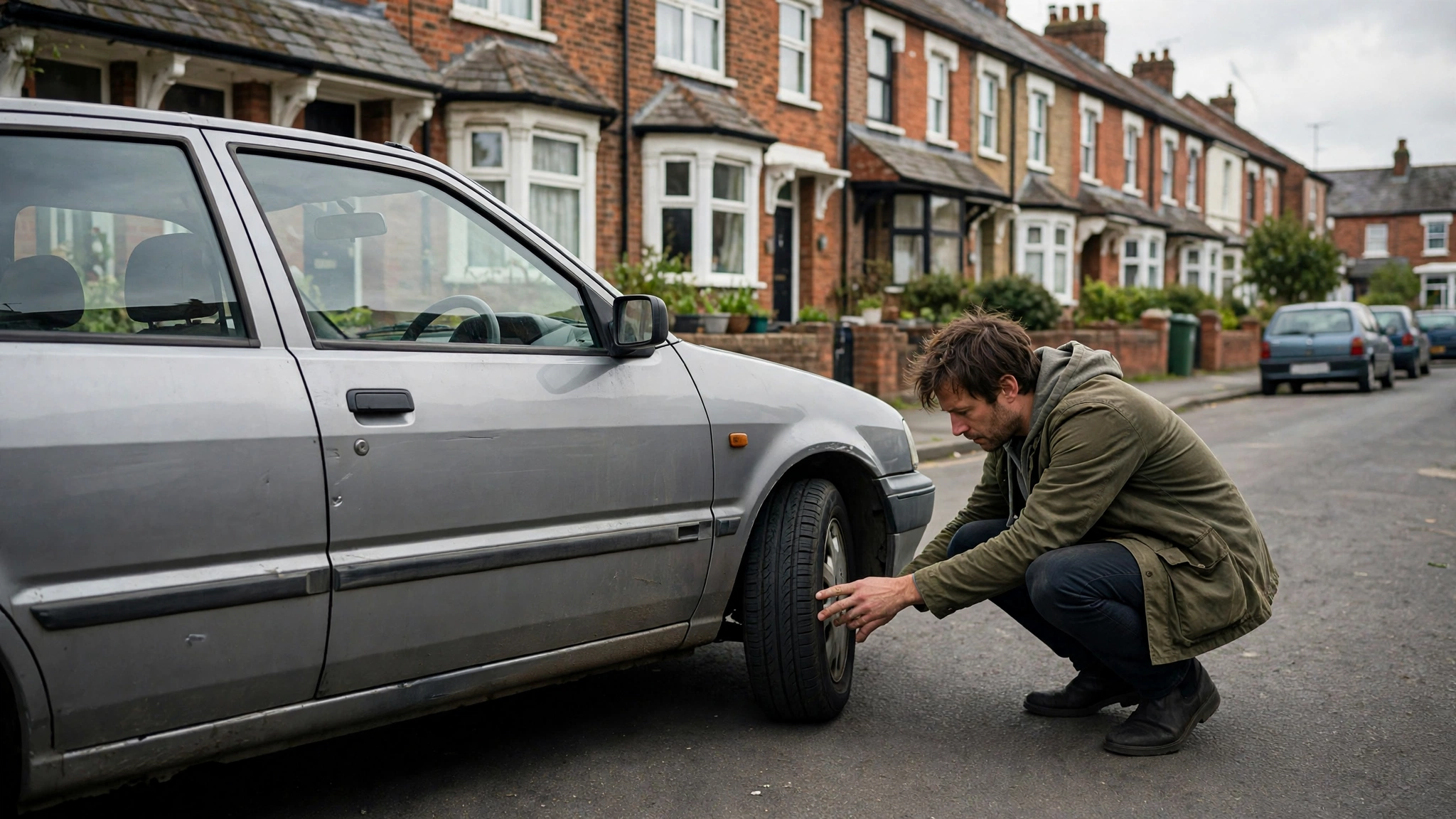
Tyres are an honest witness. Check the tread across the whole width of each tyre, not just the easy-to-see edge. The legal minimum tread depth in the UK is 1.6mm across the central three-quarters of the tyre, around its whole circumference — and the DVSA tightened the advisory threshold in January 2026, so a tester now records "tyre worn close to legal limit" at 2.5mm rather than 2.0mm. Uneven wear points to tracking or suspension problems that will cost money to sort.
Check eight: dealer or private seller — know what you are trading
There is no wrong answer, but know what you are trading. A dealer will usually charge more, yet you get proper legal protection: under the Consumer Rights Act 2015, a car bought from a dealer must be of satisfactory quality, fit for purpose and as described — and if it is faulty, not as described or unfit for purpose, you can normally use the short-term right to reject it within 30 days and ask for a full refund. After 30 days, the dealer generally gets one opportunity to repair or replace it. A private sale is cheaper, but the protection is far thinner: the car must match its description and the seller must have the right to sell it.
Check nine: haggle with evidence, and write it down
Negotiate with evidence, not theatre. Diesel cars are the slowest sellers, taking an average of 32 days to leave forecourts in October against 27 days for the market as a whole, and used petrol cars averaged £14,625 in September, down 1% on a year earlier. Be polite, be specific, and know your walk-away figure before you start. Whatever you agree — work to be done, a fresh MOT, a service, a second key — get it written down before money moves.