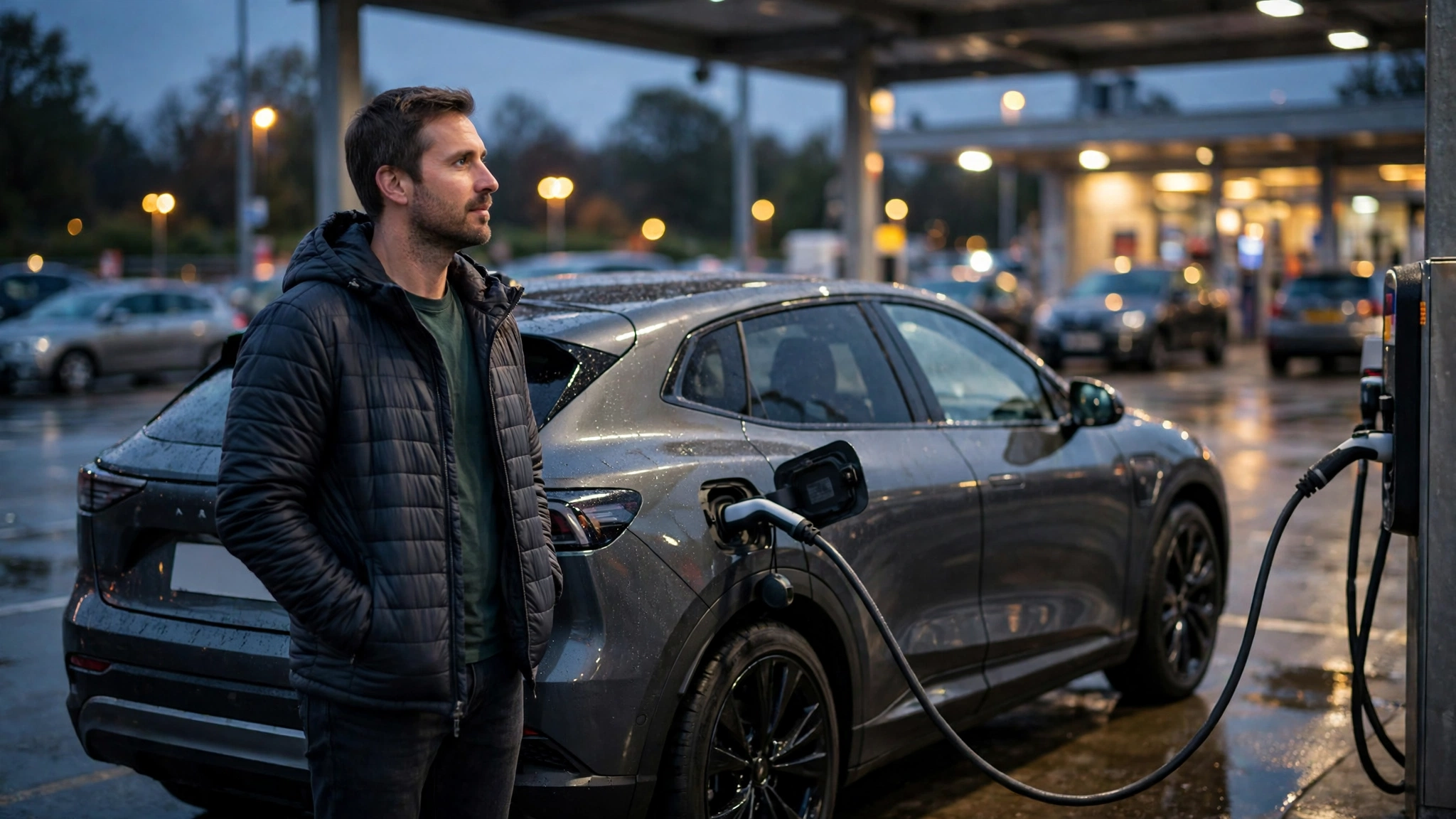
Almost one in three new cars registered in Britain in October was fully electric. Figures published by the Society of Motor Manufacturers and Traders (SMMT) on 5 November 2026 show 48,858 battery electric cars joined the roads last month, up 32.7% on a year earlier and good for a 32.0% share of the market — the highest monthly share of 2026. Petrol, still the largest single fuel type, fell to 56,876 registrations and a 37.2% share, down from 44.4% in October 2025. The gap between petrol and electric is now 5.2 percentage points — the smallest it has ever been.
The market as a whole grew 5.4% to 152,730 cars, its 11th consecutive monthly increase, and plug-in hybrids did much of the rest of the growing: registrations rose 30.1% to 22,898, a 15.0% share, while conventional hybrids slipped 5.0% to 18,287. Add the hybrids to the plug-ins and cars with a battery doing at least some of the work accounted for 59.0% of October registrations. Across the first ten months of the year, 503,805 battery electric cars have been registered, up 30.4% on the same period of 2025, for a 26.6% share.
The headline figure flatters the underlying picture, and the SMMT says so itself. Under the UK's Zero Emission Vehicle mandate, battery electric cars are supposed to make up 33% of each carmaker's new car sales this year — but the SMMT's latest outlook expects 27.2% for 2026 as a whole, with the gap widening to a forecast 32% against a 38% target in 2027 and 37.5% against 52% in 2028. "Almost one in three new cars registered in October was electric — great progress in the transition, but one that comes at enormous cost," said SMMT chief executive Mike Hawes. "The industry and government are spending billions to help drivers switch, but that support cannot be sustained indefinitely with the gap to mandated targets set to more than double by 2028, just as a new EV-only tax is introduced."
Manufacturers are paying for the growth. The SMMT says carmakers have committed £14.3 billion to UK electric vehicle manufacturing since 2020, and have spent billions more on discounts, low and 0% finance, deposit contributions and even subsidised charging to push sales towards the mandate targets — support it warns is eroding profitability and cutting trade-in values for owners. Choice is no longer the constraint: more than 180 battery electric models are on sale in the UK, with an average range above 300 miles, and the best-selling electric car in October was the Skoda Enyaq, with 1,568 registrations, ahead of the Mini Countryman on 1,494 and the Jaecoo 5 on 1,465. The government's Electric Car Grant, opened on 15 July 2025, adds up to £3,750 off eligible new cars priced at £37,000 or less — £1,500 for the second band — and runs until 31 March 2030, with more than 60 models eligible and 20 qualifying for the full £3,750, according to Auto Express's count on 8 October 2026.
But the cost of running an electric car now depends more on where you charge it than on which car you buy. Zapmap's price index for October 2026 puts the average pay-as-you-go price on standard public chargers at 54p per kWh — 16p a mile — and on rapid and ultra-rapid chargers at 82p per kWh, or 24p a mile. At home, the picture is very different: the Ofgem price cap put household electricity at 26.32p per kWh from 1 October 2026, and an overnight electric-vehicle tariff costs around 8.5p per kWh — the rate EV Powered uses in its worked example below. Worked out over 10,000 miles a year, EV Powered calculates £250 a year on an overnight tariff, £770 at the standard cap rate, £1,600 on standard public chargers and £2,300 on rapid chargers — a nine-fold gap between the cheapest and dearest way to fill the same car.
Rapid charging is also getting dearer. Zapmap's October 2026 survey of the top ten rapid networks found prices ranging from 51p per kWh on Tesla's public network to 92p on InstaVolt, the dearest of the ten. Tesla drivers using the full Supercharger network paid an average of 48p per kWh, while non-Tesla drivers at Supercharger sites open to all cars paid 69p. Sainsbury's Smart Charge, Fastned and Believ all charged 79p. The gap matters because it decides who the switch actually saves money for: a driver with a driveway and an overnight tariff pays a fraction of what a driver relying on motorway rapids pays for the same miles.
Policy is pulling in both directions. The Budget on 28 October 2026 confirmed a new electric-vehicle-only tax, known as eVED, from 2028, and proposed keeping VAT on public charging at 20% while domestic electricity is currently VAT-free — a split the SMMT says "sends mixed messages to consumers". The industry is now urging the government to revise the mandate targets down to reflect demand, with the SMMT warning that higher targets "may force supply, but they do not create demand". The mandate review, the SMMT says, "must deliver substantive reform effective immediately to ensure we have a healthy market and an attractive pitch to investors" — a market on which 188,000 UK jobs depend, according to the trade body.
One fear, at least, is fading. AA figures show that running out of charge accounted for just 1.85% of the breakdowns it attended for electric cars in 2024, down from 8.26% in 2015 — and the AA says the top faults for electric cars are the same as for petrol and diesel cars: tyres, wheels and the 12-volt battery. With petrol at 172.78p a litre in the week beginning 2 November 2026, according to government figures, the maths of switching now turns on a single question most buyers never asked five years ago: not how far the car goes, but where it will be plugged in tonight.
electric cars
Electric Cars Took a Third of New Sales in October — But the Charging Bill Depends on Where You Plug In
Battery electrics hit a 32% share in October, SMMT figures show — yet rapid charging now costs 82p per kWh, nearly ten times an overnight home tariff.