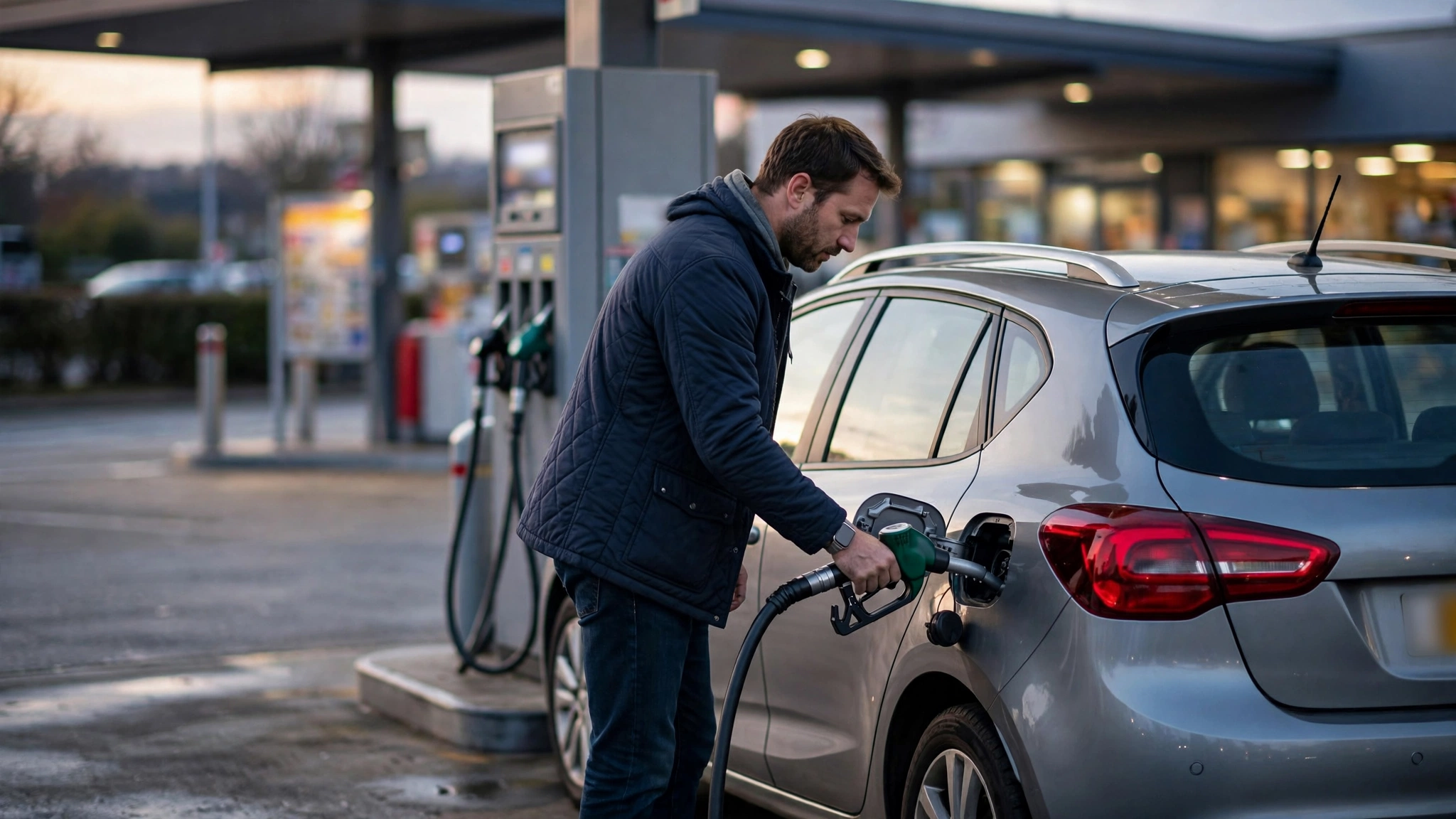
In the week commencing 2 November 2026, the average UK pump price was 172.78p a litre for unleaded petrol and 198.58p a litre for diesel, according to the Department for Energy Security and Net Zero's weekly road fuel prices. Diesel had only just come back below £2: on 2 October 2026, RAC Fuel Watch recorded an average diesel price of 200.01p a litre — the first time diesel has ever averaged £2, beating the previous record of 199.09p set in June 2022. Petrol stood at 174.71p on the same day. What follows is what is inside those numbers.
Oil: the raw material, traded in dollars
Petrol and diesel are made from crude oil, and crude is traded around the world in US dollars. When the global oil price rises, the cost of the raw material behind every litre rises with it. When it falls, pump prices should eventually follow — and the gap between those two movements is the story of 2026.
March 2026 showed how fast it can move. On the back of the conflict with Iran, average prices rose by record monthly amounts: a litre of unleaded rose by 20p in March, from 132.83p on 1 March to 152.83p by the end of the month, and diesel rose by 40p, from 142.38p to 182.77p. RAC head of policy Simon Williams said: "March has been truly unprecedented — fuel prices have never risen this fast in a single month. The increases drivers have had to endure in March 2026 far exceed those seen in the early days of the war in Ukraine."
Then, in the first week of November, the market turned the other way. Brent crude fell 7.63% on 2 November 2026 to settle at $104.77 a barrel — its biggest daily fall since July — as hopes of US–Iran peace talks eased fears of prolonged supply disruption. By 6 November Brent was at $98.32. The pump price had not followed by the same amount, and it rarely does: the fuel in a garage's tanks today was bought at yesterday's prices, and retailers argue they cannot cut prices until cheaper stock arrives. Oil is the volatile slice. It explains the sharp moves, the weeks when the board jumps for no local reason at all. But it is not the biggest slice.
The pound: the quiet multiplier
Because oil is priced in dollars, the strength of the pound quietly shapes what you pay. When the pound weakens against the dollar, the same barrel of oil costs more in British money, even if the global price has not moved at all. When the pound strengthens, there is room for prices to ease. A flat oil price and a weaker pound still means a dearer litre; a falling oil price and a weaker pound can cancel each other out entirely, which is why drivers sometimes feel cheated by a fall in oil that never reaches the pump.
Tax: the steadiest slice, and the one the Budget just froze
Fuel duty is charged at a fixed rate per litre, and VAT at 20% is then applied on top of the whole price — duty included. The duty rate on petrol and diesel is 52.95p a litre. It has sat there since 6pm on 23 March 2022, when the Spring Statement cut the long-frozen 57.95p rate by 5p.
The Budget on 28 October 2026, delivered by Chancellor John Healey, extended that 5p cut for another six months, to 1 July 2027, cancelling the rises that had been planned for January and March 2027. The government puts the saving for the average car driver at around £230 compared with previously published plans. But the extension is not a cut, and the date after it matters: on 1 July 2027 the rate rises to 60.59p a litre — the 5p cut ends and the rate is uprated by RPI at the same time. That is a 7.64p rise in duty, or 9.17p a litre at the pump once VAT is added.
So how much of today's price is tax? At the 2 November averages, the arithmetic is straightforward. On a litre of petrol at 172.78p, duty is 52.95p and VAT — a fifth of the price including duty — is 28.80p, giving a tax total of 81.75p, or about 47% of the price. On a litre of diesel at 198.58p, duty is 52.95p and VAT is 33.10p, a tax total of 86.05p, or about 43%. Tax is the largest single slice of the price, but it is not, as is often claimed, "well over half" — and because duty is fixed per litre, it does not rise when oil rises. That also means the government benefits when prices rise: the duty stays the same, but the VAT take grows with the higher price.
Local competition: why the next town is cheaper
If oil, the pound and tax are national, why does fuel cost more on one side of a county than the other? The answer is competition — or the lack of it. In towns with several stations fighting for custom, prices are keener. In rural areas with one garage for miles, they are not. Supermarket forecourts have traditionally been among the cheapest places to fill up, while motorway service stations sit at the other end of the scale, charging a premium to drivers who have little choice mid-journey. The gap between the cheapest and most expensive forecourt in an area can be wide enough to matter over a year of driving.
You cannot control the oil market, the exchange rate or the tax system. But there is still room to spend less: shop around, using price-comparison apps and a glance at forecourt boards on your regular routes — a short detour for a full tank can be worth it, while for a small top-up it probably is not. Ease off the accelerator, because smooth driving — gentle acceleration, reading the road ahead, avoiding harsh braking — uses noticeably less fuel than aggressive driving, and it is kinder to the car. Check your tyre pressures; under-inflated tyres increase fuel consumption and wear out faster, and the correct pressures are listed in the handbook or on a sticker inside the door frame or fuel flap. Lighten the load: roof boxes, bike racks and a boot full of clutter all add weight and drag, so take them off when you are not using them.
What to watch next
Two dates now frame the price at the pump. The first is 1 July 2027, when duty jumps to 60.59p a litre and adds 9.17p to every litre overnight unless the government changes course again. The second is whatever happens next in the oil market: Brent fell from $113.43 at the close on 30 October to $104.77 on 2 November and $98.32 by 6 November, and if that fall holds, wholesale prices should follow — the question, as ever, is how much of it reaches the forecourt, and how fast.