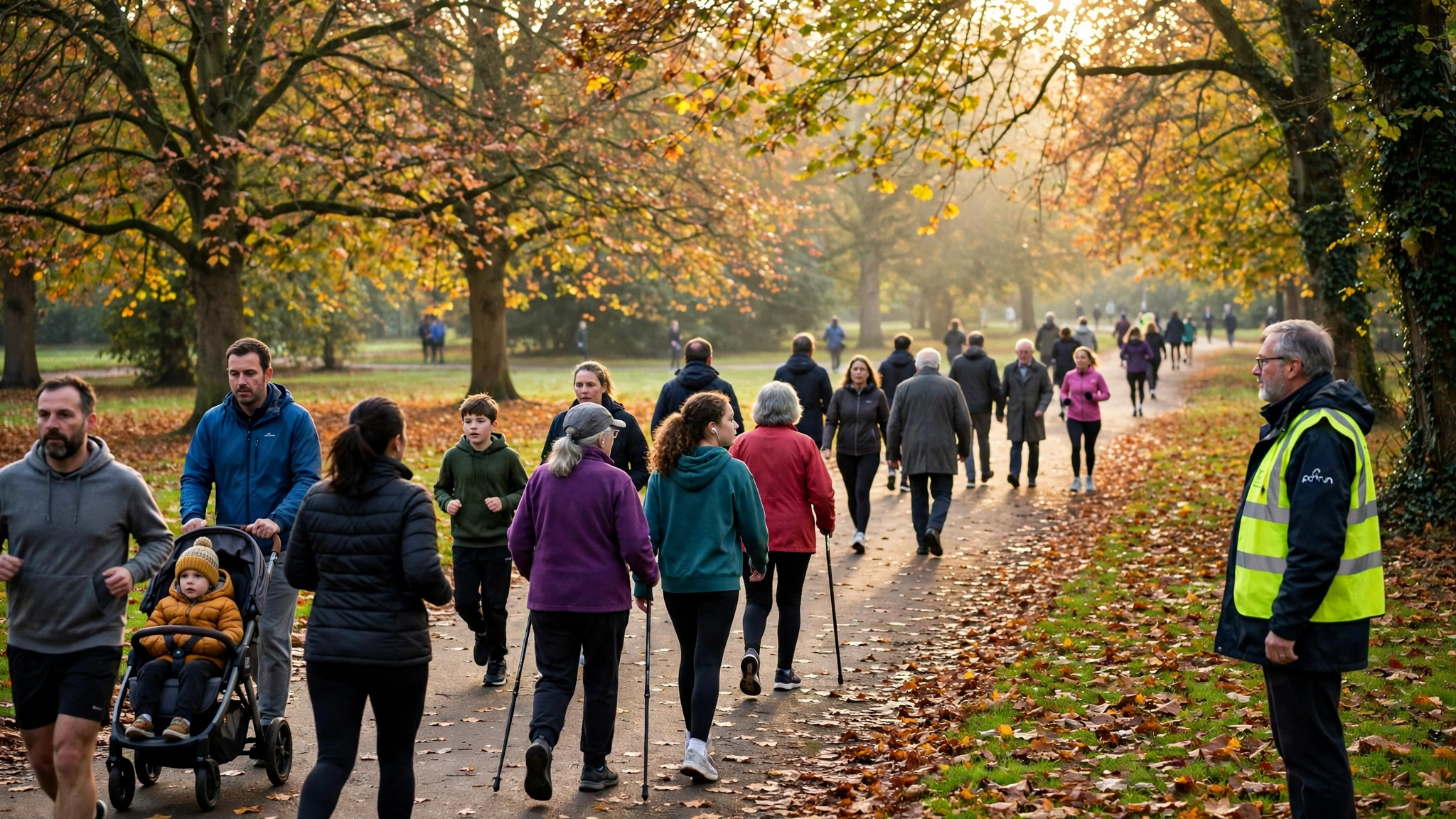
Around 7.1 million adults in England now run, up by more than 500,000 in a single year, according to Sport England's latest Active Lives Adult Survey — the clearest sign yet that running has become the country's defining post-pandemic sport. The survey, covering November 2024 to November 2025 and published in April 2026, found that 64.6% of adults — 30.9 million people — met the Chief Medical Officers' guideline of 150 minutes or more of moderate intensity physical activity a week, an increase of 859,000 adults on the previous 12 months and the highest level since the survey began in 2015.
Running is leading that growth. Walking for leisure remains the most popular activity, with around 22.9 million adults taking part, but its participation has stabilised after years of strong growth. Fitness activities grew to 15.3 million adults, up 921,000 on the previous year. Cycling for leisure sits at around 6.1 million, slightly up on last year but still below longer-term levels, while swimming, at 4.4 million, and team sports, at 3.5 million, remain below their pre-pandemic highs. The shift, Sport England says, is towards more flexible, individual ways of being active rather than structured or organised sport — and nothing fits that description better than a run from your own front door.
"It’s great to see continued growth in the number of people taking part in physical activity, with more adults than ever enjoying the benefit of playing sport and moving," said Simon Hayes, Sport England's chief executive. "It is testament to the incredible work of so many people across the sector, including the millions of volunteers without whom the system could not operate." Hayes added that the progress is still not being felt equally: where people live, their socio-economic circumstances, their gender and their ethnicity all still have a significant impact on how likely they are to be active.
The gap is stark. Just 53.8% of the least affluent adults are active, compared with 73.2% of the most affluent. Disabled people and those with long-term health conditions sit at 49.1% active, and only 44.3% of adults aged 75 and over. Women, at 62.2%, are still less likely to be active than men, at 67.3%, and Black adults (57.2%) and Asian adults (56.3%) are less likely to be active than White adults. Sports Minister Stephanie Peacock said the government is backing a place-based approach to sport funding, "with £250 million through Sport England to reach local places with the highest levels of inactivity and at least £400 million into multi-sport community facilities".
Nowhere is the running boom more visible than on the streets of London each spring. The 2025 TCS London Marathon, run on 27 April 2025, set a Guinness World Records title for the largest number of finishers in a marathon, with 56,640 people crossing the finish line on The Mall — beating the 55,646 set by the New York City Marathon in November 2024. The race had already drawn a record 840,318 ballot applications, the most for any marathon ever. Hugh Brasher, chief executive of London Marathon Events, said: "We are thrilled to have broken the Guinness World Records title for the largest number of finishers in a marathon at yesterday's TCS London Marathon. It was a fantastic occasion to see 56,640 people cross the iconic Finish Line on The Mall throughout Marathon Day." The 45th edition of the race also produced 41 new Guinness World Records titles from 87 attempts.
For most new runners, though, the starting line is not The Mall but a local park on a Saturday morning. On 7 November 2026, parkrun's weekly figures recorded 228,000 parkrunners across 880 events in the UK, plus 30,000 junior parkrunners at 479 junior events, supported by 34,000 volunteers. Bushy Park, where parkrun began in 2004 with 13 runners, was the biggest event that Saturday with 1,512 finishers, ahead of Southampton with 1,242 and Clapham Common with 1,184. Worldwide that week, around 25,000 people registered for their first parkrun barcode and around 16,000 people became parkrunners.
What makes parkrun different from a race is that walking counts too — and walking is now one of its fastest-growing parts. In the UK alone, walks at parkrun increased from 299,000 in 2024 to 381,000 in 2025, according to parkrun's own figures published in April 2026. Globally, walks rose from 1.37 million to 1.6 million over the same period, an average of 30,000 walks every week, with nearly nine percent of all parkrun finishes worldwide now taken by walkers. In 2025, people volunteered as parkwalkers 55,315 times in the UK, and there were 96,449 tail walker volunteer moments — the volunteers who walk at the back so that nobody ever finishes last.
The walking habit is spreading unevenly in encouraging ways. At Great Yarmouth North Beach, walkers made up more than 19% of finishers in 2026, helped by a difficult sandy beach course. At Mote Park, the parkwalker volunteer role was fulfilled 388 times in 2025. The idea is simple: a free, timed 5K every Saturday at 9am, open to runners, joggers and walkers alike, with no entry fee and no cut-off time.
For anyone who has never run at all, the route in is just as free. The NHS Couch to 5K programme takes nine weeks, three runs a week, building from one minute of running alternated with ninety seconds of walking in week one to 30 minutes of continuous running by week nine, with rest days between sessions. It is the plan most beginners actually use, and it is designed for people starting from no running at all. A Saturday parkrun then gives that plan a fixed point in the week: register once online, bring your barcode, and turn up.
Winter is when most beginners quit, and it is also when the habit matters most. Dark evenings call for bright or reflective clothing and well-lit routes, and icy pavements are a reason to swap a run for a walk rather than to stop altogether. That is the other lesson of the parkrun figures: the events that keep growing are the ones where walking is treated as a proper way to take part, not a failure to run. Rain, mud and sideways drizzle are part of the deal in Britain, and the numbers suggest more people than ever are deciding that is a price worth paying.
The boom has not reached everyone, and Sport England's own figures say so: the least affluent, disabled people, older adults and some ethnic groups are still far less likely to be active. But the free end of the sport is growing fastest of all. On Saturday 7 November 2026, 228,000 people ran, jogged or walked a parkrun in the UK, 30,000 children did a junior parkrun, and 34,000 volunteers gave up their morning to make it happen — and next Saturday at 9am, in more than 880 parks, it all starts again.
running
Britain's Running Boom: 7.1 Million Adults Now Run as parkrun and the Marathon Break Records
Running in England has grown by more than half a million adults in a year, Sport England reports, while parkrun drew 228,000 people on a single Saturday.