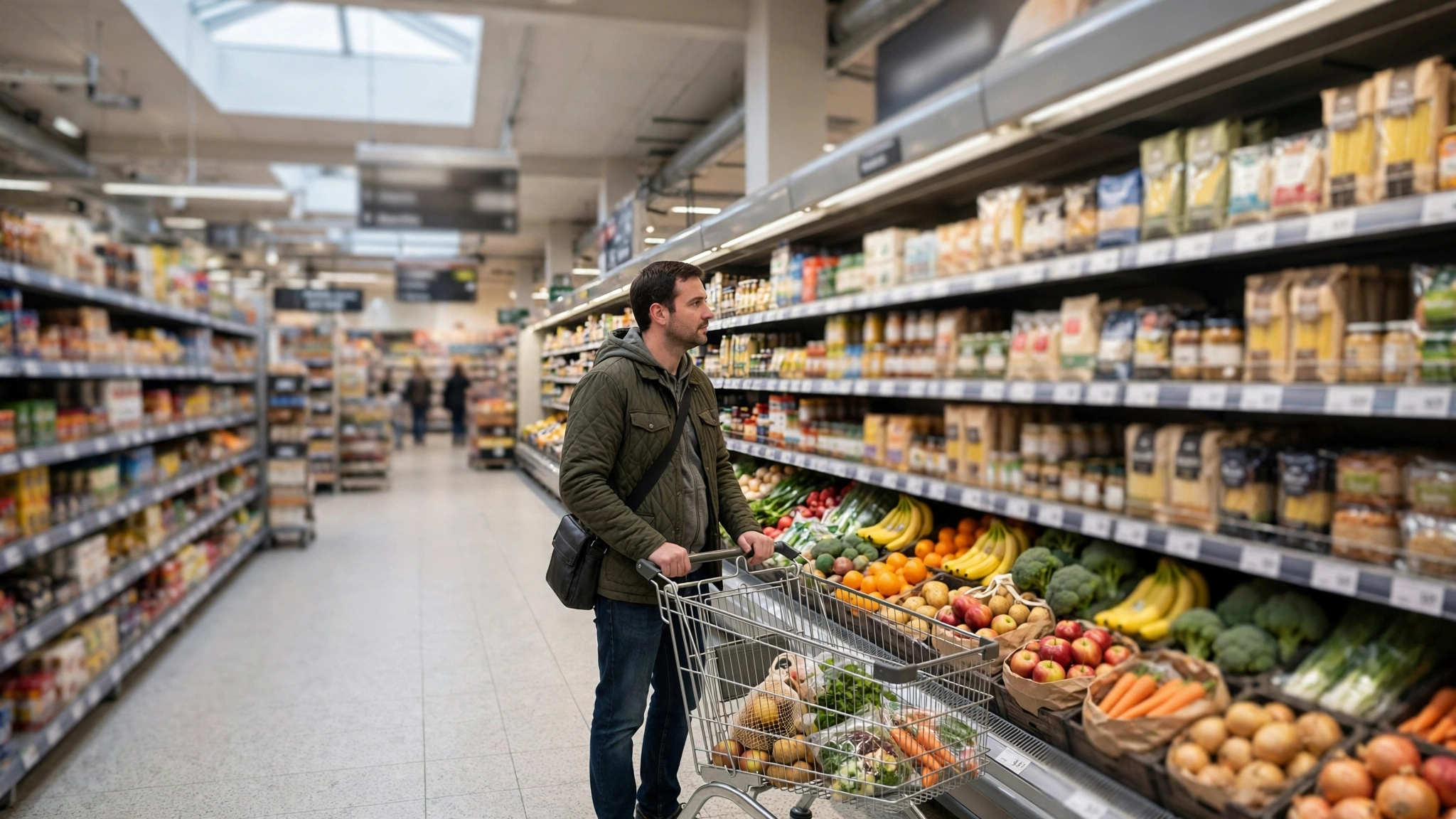
Why does the shop still feel expensive when inflation has cooled? It is the question asked at checkouts across the country, usually while staring at a total that looks wrong for a basket that looks ordinary. The official figures say food inflation has cooled from its peak. The trolley in front of you says something else. Both, frustratingly, are telling the truth — and the gap between the two is where the whole argument lives. One lens is the official measure. The other is the trolley itself.
Lens One: The Official Measure
The latest official figures, published by the Office for National Statistics on 21 October 2026, put food and non-alcoholic drink inflation at 1.3% in the 12 months to September 2026 — unchanged from August, and the lowest rate since September 2021, when it was 0.8%. Prices in the category actually fell by 0.2% during September itself. Overall consumer price inflation, the CPI, was 3.5% in the same twelve months.
That is a long way from the peak. Food and non-alcoholic drink prices rose by 19.2% in the year to March 2023, the highest annual rate for more than 45 years, according to the ONS. The fall since then has been steady but the level has not come back down — and that distinction is the whole story. Inflation is a measure of speed, not of level: when inflation "falls", prices are climbing more slowly, but the trolley still costs more than it did last year. For prices to actually fall across the board would need sustained deflation in food, which is rare. So for most staples, the new prices are, broadly, the prices.
The more up-to-date industry measures tell a similar story with a slightly sharper edge. Worldpanel by Numerator put grocery price inflation at 2.5% in the four weeks to 4 October 2026, up from 2.3% the month before. The British Retail Consortium's shop price monitor for October 2026 put food inflation at 2.9%, up from 2.5% in September, while overall shop price inflation reached 2.1%, the fastest in two and a half years.
Lens Two: The Trolley
Look at the trolley itself, and a different picture emerges — one made of smaller changes that the official measure smooths over. The first is shrinkflation: the product stays the same price, or even creeps up slightly, while the pack gets smaller. Consumer group Which? gathered the latest examples from shoppers in October 2025, and they are specific enough to check on the shelf.
Aquafresh Complete Care Original toothpaste went from £1.30 for 100ml to £2 for 75ml at Tesco, Sainsbury's and Ocado — a 105% rise per 100ml. Sainsbury's Scottish Oats halved in size, from 1kg to 500g, while the price rose from £1.25 to £2.10, a 236% rise per 100g. KitKat two-finger multipacks fell from 21 bars to 18, while the price at Ocado rose from £3.60 to £5.50, a 53% jump. Quality Street tubs were cut from 600g to 550g while the price at Morrisons rose from £6 to £7. Bottles of Gaviscon heartburn liquid shrank from 600ml to 500ml while the price at Sainsbury's stayed at £14, a 20% rise per 100ml. And Cadbury multipacks of Freddo and Fudge bars dropped from five bars to four at Morrisons, Ocado and Tesco, with the £1.40 price unchanged.
Individually, each change is small enough to miss. Together, they mean the price per kilo or per litre — the unit price printed in small type on the shelf edge — has risen by more than the sticker suggests. Some products have not just shrunk but changed what they are: Which? found White KitKats now contain less than 20% cocoa butter, so they can no longer be marketed as white chocolate, and McVitie's Penguin and Club bars now use more palm and shea oils than cocoa, so they can no longer legally be called chocolate biscuits.
The Loyalty-Price Divide
The second trolley change is the loyalty price divide. Walk down today's aisles and a second pricing system stares back at you: one price for everyone, and a lower one for members. Tesco's Clubcard Prices, Sainsbury's Nectar Prices, Morrisons More, Asda Rewards and Lidl Plus have spread from a few promotions to a central part of how the big chains compete. Supermarkets argue this rewards their regulars. Critics argue that the "normal" shelf price has quietly become the penalty price — the one paid by anyone without the app, including some older shoppers and those least comfortable with smartphones.
The Competition and Markets Authority examined the question in detail, publishing its review of loyalty pricing on 27 November 2024 after analysing around 50,000 products on member-price promotions at five supermarkets: Tesco, Sainsbury's, Waitrose, Co-op and Morrisons. Its findings were mostly reassuring: 92% of loyalty prices were genuine savings against the product's usual price, the average member saving was 17% to 25% on the promoted item, and only 0.6% of cases showed the pattern people worry about, where the non-member price was pushed up during the promotion. But the member price was not always the cheapest available — of 429 branded products it compared across up to six other supermarkets, 61 were cheaper somewhere else.
The practical consequence is simple: shopping without the loyalty scheme of whichever store you are in now costs noticeably more. Many families hold cards for several chains and plan their shop around whichever is cheapest that week.
The Third Change: The Trolley Itself
The third change is in the trolley itself. Own-brand ranges — once the embarrassed budget option — have grown enormously in quality, range and popularity, from basic value lines to premium own-label ranges that compete directly with the famous brands they sit beside.
Behind all three changes sits a chain that starts long before the supermarket. Energy costs hit everything from heating greenhouses to running delivery fleets. Harvests — here and in the countries Britain imports from — can be ruined by a wet spring or a dry summer, and the price of the ingredients that do survive rises accordingly. The Food and Drink Federation noted in October 2026 that manufacturers were paying nearly 40% more for ingredients and energy than in January 2020, alongside higher national insurance costs and a new packaging tax. That chain is also why prices respond slowly and unevenly: a fall in global costs takes months to filter into a loaf on a shelf in Manchester, arriving long after the headlines have moved on.
The Verdict
So which lens wins? Neither, on its own — and that is the verdict. The official measure is right that the sharp rises are behind us: food inflation at 1.3% in September 2026 is a different world from 19.2% in March 2023. And it is wrong if it is read as saying shopping has got cheaper. The trolley is right that the weekly bill still hurts, and wrong if it is read as saying prices are still soaring at their old pace.
The weekly shop may never feel cheap again. Compare the unit price, not the sticker. Use the loyalty scheme of the store you are actually in. Shop to a list.