Learners in Great Britain waited an average of 19.7 weeks between booking and taking a practical driving test in September 2026, according to the Driver and Vehicle Standards Agency. That is the lowest average wait since November 2024 — and it is still nearly five months. Almost three in ten tests that month, 29%, were taken more than 21 weeks after booking. The backlog built up during the pandemic has not gone away; it has only begun to shrink. And that is the fact every learner needs to understand first: in 2026, passing first time is not just about pride. A fail means joining a queue that is still months long.
The DVSA's own September 2026 release tells both sides of the story. The agency conducted 191,682 practical tests in the month, and more than 2.16 million in the 12 months to September 2026 — the highest rolling 12-month figure on record. Examiner numbers are at their highest since November 2017. Roads Minister Justin Madders said: "We inherited record waiting times and a significant backlog, and while driving test waiting times are still not where we want them to be, these figures show real progress is being made." The government had set a target of cutting the average wait to seven weeks by summer 2026. September's 19.7 weeks shows that target was not met — but the direction, at last, is down.
The odds: half of candidates fail
In April 2025 to March 2026 the DVSA conducted 1,998,621 practical car tests in Great Britain, and exactly half of candidates passed: a 50.0% pass rate. The first-attempt rate was barely different, at 50.5%, and by the sixth attempt or later it falls to 43.8%.
The theory test is no easier. In 2025/26, 2,924,430 car theory tests were taken and only 44.8% were passed. The theory test costs £23, the practical test £62 on a weekday or £75 on an evening, weekend or bank holiday, and a provisional licence costs £34 online — £119 in official fees for a learner who passes everything first time. Every failed theory adds £23; every failed practical adds £62 or £75, plus months of waiting for a new slot. That is why the preparation below is worth more than the test fee.
The three faults that fail most tests
The DVSA publishes the faults examiners record most often, and in 2025/26 the top three were the same as ever: observation at junctions, use of mirrors when changing direction, and turning right at junctions. Junction observation has topped the list for years. That ranking should shape every lesson. You can pass with up to 15 minor driving faults, but a single serious or dangerous fault fails you outright. The faults that fail people are not exotic manoeuvres; they are the first things you are taught — looking properly at junctions, checking mirrors before signalling or changing lanes, and positioning correctly for a right turn.
Theory: read the Code, don't just drill questions
Before you can book a practical test, you need to pass the theory test, and it deserves more respect than many learners give it. It comes in two parts taken at the same sitting: 50 multiple-choice questions on the rules of the road, of which you must answer 43 correctly, and a hazard perception section of 14 video clips, where you need 44 out of 75 points. The Highway Code is the foundation of both, and reading it properly, rather than just drilling practice questions, is what carries you through the questions you have not seen before. Book through the government website — beware copycat sites that charge extra for the same appointment — and remember the pass lasts two years.
Finding an instructor who suits you
A good instructor makes an enormous difference, and the cheapest is rarely the best value. Look for an approved driving instructor, shown by the green badge displayed in their windscreen, and ask around locally. Recommendations from friends, colleagues and neighbourhood groups are usually worth more than adverts, because they tell you about punctuality, patience and whether the instructor explains things calmly or shouts. Take an introductory lesson before committing to a block booking, and ask for a mock test: the DVSA's Ready to Pass campaign found nine out of ten learners who took one said it helped.
Private practice: the rules that come with a family car
Practising between lessons in a family car can save money and build confidence, but the rules are strict. Your supervising driver must be over 21, hold a full licence for the type of car you are driving, and have held it for at least three years. They must be fit to drive, and must not use a mobile phone while supervising you.
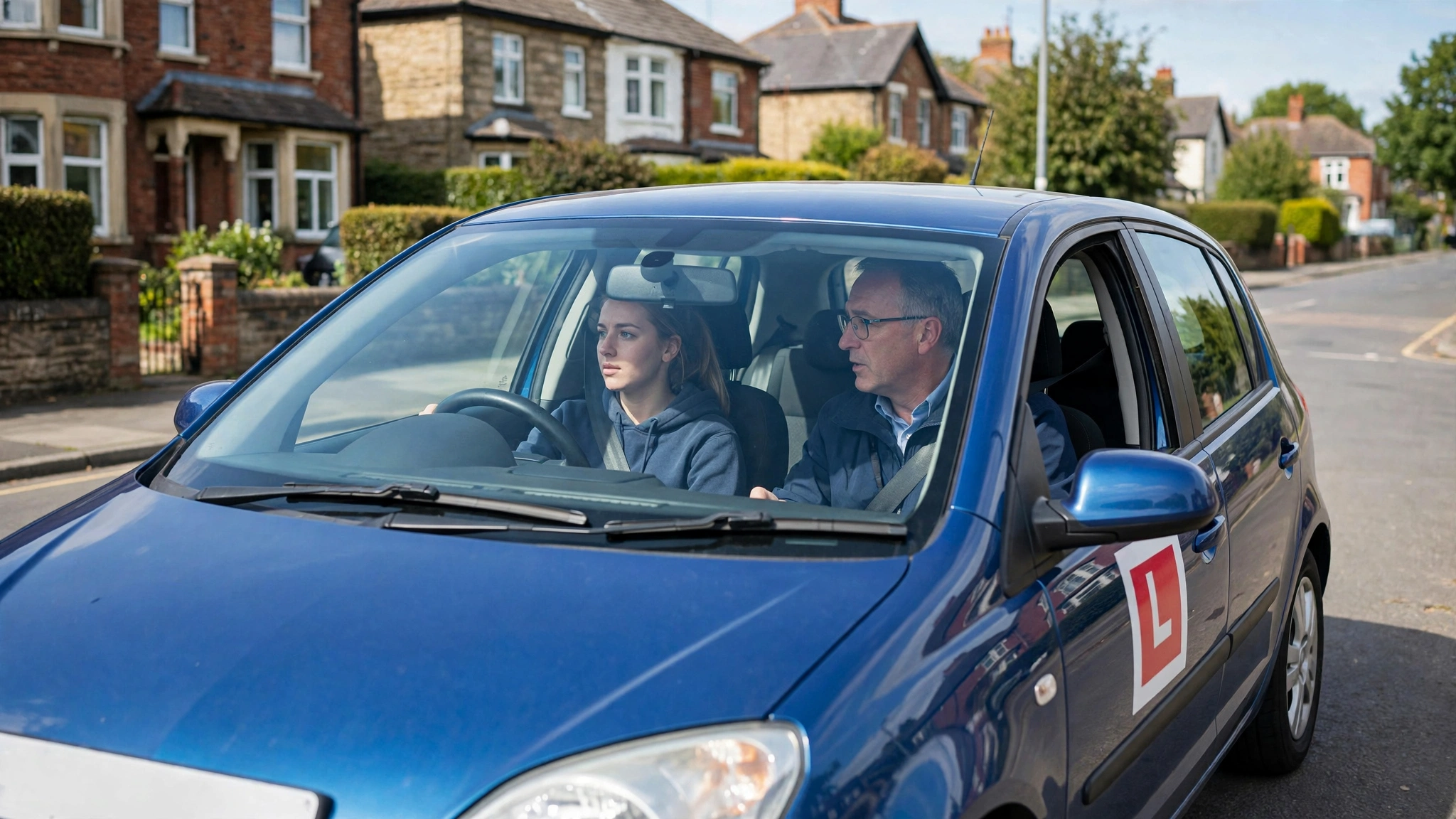
You must display L plates, or D plates in Wales, clearly at the front and back. Insurance is the part families most often get wrong: you personally must be insured to drive that car as a learner, whether through a dedicated learner policy or by being added to the owner's insurance. Driving uninsured, even "just round the block", risks points on a licence you have not got yet. Learners are not allowed on motorways unless they are with an approved instructor in a dual-controlled car, and your provisional licence must be in place before you drive anywhere at all.
Test day: forty minutes, one junction at a time
The practical test lasts around forty minutes, including about twenty minutes of independent driving following a sat nav or road signs. Examiners watch for safe, legal, considerate driving, and a minor slip handled safely is treated very differently from a fault that affects other road users.
You will be asked to carry out one reversing manoeuvre — a parallel park, parking in a bay, or pulling up on the right and reversing a short distance before rejoining the traffic. You may also be asked to do an emergency stop, though that comes up in roughly one test in three. Practise them until they feel boring: slow, careful and observant beats quick and flashy every time.
The vehicle safety questions come in two flavours. The "tell me" question is asked before you set off, when you explain how you would check something, such as the brakes or the tyre pressures. The "show me" question happens on the move, when you operate a control, perhaps washing the windscreen or demisting the rear window.
Booking in a backlog: the rules changed in 2026
Booking itself has changed. From 8 April 2026, learners are solely responsible for booking their own test, and from 9 June 2026 a booking can be changed at most twice, and moved only to one of the learner's three nearest test centres. The DVSA says the changes are aimed at stopping third-party sites and apps that promise quick slots for hefty fees — a persistent problem, and some are little more than scams. Book only through the official government service, and be ready to check for cancellations: slots do come up, and a cancelled slot is often the fastest way through a 19.7-week queue.